
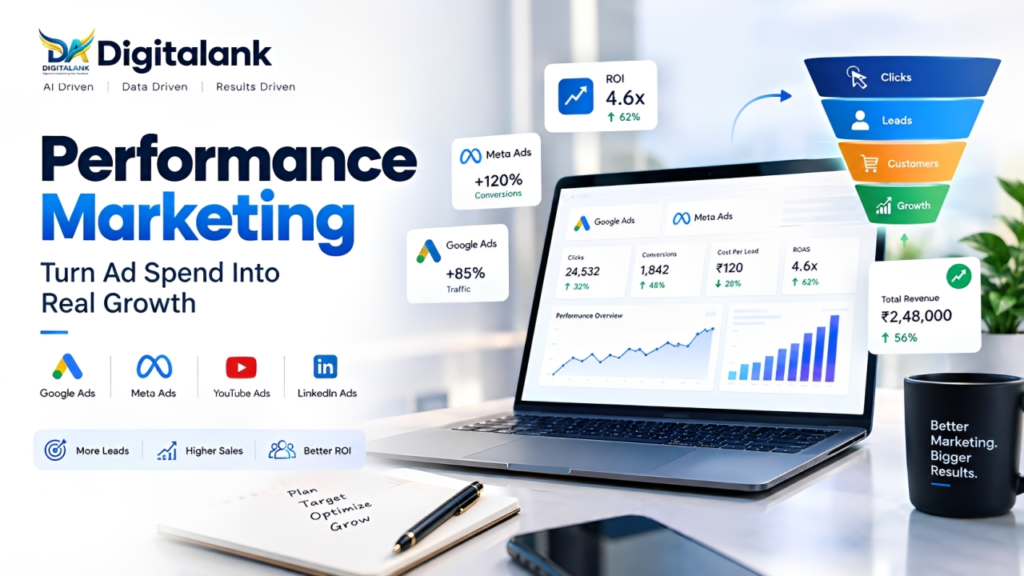
In todays world simply posting an advertisement no longer matters. Businesses want to know one important thing: “How much business are we actually getting from our marketing spend?”
Here comes performance marketing.
Performance marketing is a data-driven approach where Businesses focus on results like leads, sales, app installs, conversions or customer acquisitions. Of spending the budget without knowing the result businesses control and optimize the campaigns.
At Digitalank we think that the success of marketing is not just about the clicks; it is about measurable business results.
What Is Performance Marketing?
Performance marketing is a type of marketing in which campaigns are developed and optimized to achieve specific business goals.
These goals can be:
- Lead generation
- Online sales
- WhatsApp inquiries
- Website conversions
- App installs
- Customer acquisition
- ROAS improvement
Digital platforms such as Google Ads, Meta Ads, YouTube Ads, LinkedIn Ads and others can be used to reach the business goals.
The main difference is that performance marketing implies lots of data, tracking, testing and optimization.
Why Is Performance Marketing Important for Businesses?
With a traditional marketing approach it can be challenging to understand the source of the customer.
Using performance marketing Businesses can track metrics through the whole customer journey.
Here are some examples of the questions a campaign can answer for you:
₹10,000 Ad Spend → 50,000 Impressions → 2,000 Clicks → 150 Leads → 20 Customers
By understanding this data Businesses can optimize their campaigns.
Now of wondering “How was the performance of the advertisement?” Businesses can ask other questions:
- How many leads have we generated?
- What is our CPL?
- Which audience was the most effective?
- Which advertisement was the most effective?
- Which campaign generated the revenue?
- How much do we pay for one customer?
Key Components of Performance Marketing
- Paid Advertising
Paid advertising is one of the components of performance marketing.
Depending on the business objective companies use:
- Google Search Ads
- Google Display Ads
- YouTube Ads
- Meta Ads
- LinkedIn Ads
- Remarketing campaigns
The choice of the advertising platform depends on the target audience, industry, product, budget and the business objective.
- Audience Targeting
Running an ad for everyone can be not a way to proceed.
Performance marketing uses audience data to reach people who’re more likely to convert.
For example e-commerce companies target:
- Website visitors
- Viewers of the product
- Cart abandoners
- customers
- Lookalike audiences
- Users with the relevant interests and demographics
Better audience targeting can help Businesses to make their campaigns more efficient.
- Conversion Tracking
One of the mistakes Businesses make is running ads without proper tracking.
With the help of conversion tracking companies can understand the actions that happened after the click on the advertisement.
Depending on the business conversions can be:
- Form submission
- Purchase
- Phone call
- WhatsApp inquiry
- Booking
- Sign-up
- App install
Tools such as Google Analytics 4 Google Tag Manager, Meta Pixel, server-side tracking solutions can help Businesses to measure the actions of the customers.
- Creative Testing
Even if there is an audience the advertisement can fail to convert them.
Companies continuously test different:
- Ad copies
- Headlines
- Images
- Videos
- CTAs
- Offers
- Landing pages
For example of running just one advertisement for the whole campaign Businesses can test multiple creatives and understand which is the most effective.
This process is called A/B testing or creative testing.
- Landing Page Optimization
Making someone click on the advertisement is the half of the battle.
The next step is making the visitor convert.
The perfect landing page should have:
- A clear headline
- Value proposition
- information
- Social proof or testimonials
- Clear Call-to-Action (CTA)
- Fast loading speed
- friendly design
- Easy conversion process
If the advertisement collects thousands of clicks but the landing page does not convert the visitors the budget on the advertising can be lost.
Key Performance Marketing Metrics
For the evaluation of the campaign’s performance Businesses monitor metrics.
Cost Per Lead (CPL)
CPL metric shows how much companies spend to generate one lead.
CPL = Total Ad Spend ÷ Number of Leads
For example:
If the total budget is ₹20,000 and 200 leads are generated:
CPL = ₹100
Cost Per Acquisition (CPA)
CPA is used to calculate how much Businesses pay to generate one customer or conversion.
CPA = Total Marketing Cost ÷ Number of Conversions
Return on Ad Spend (ROAS)
ROAS is a metric that’s very important for e-commerce and revenue-oriented campaigns.
ROAS = Revenue Generated ÷ Advertising Spend
For example:
If the Businesses spend ₹50,000 on advertising and generate ₹2,00,000 in revenue:
ROAS = 4X
That means companies generate ₹4 for every ₹1 spent on the advertising.
Performance Marketing vs Traditional Digital Marketing
Performance marketing is about the measurable business performance.
While in the digital marketing metrics can be:
- Reach
- Impressions
- Followers
- Engagement
- Website traffic
They can be useful. Sometimes they do not show the real growth of the business.
Unlike that performance marketing goes further. Connects marketing performance with the measurable results like:
Clicks → Leads → Customers → Revenue
That is why performance marketing is so important for the modern business growth.
Major Performance Marketing Mistakes
There are cases when Businesses spend the budget on advertising but do not get consistent results because of these mistakes.
Running Ads Without a Goal
First of all Businesses should define their goal before the campaign starts.
Is it:
- Leads?
- Sales?
- Brand awareness?
- App downloads?
- Website conversions?
Without defining the goal Businesses will face difficulties with optimizing the campaign.
Concentrating on Inexpensive Leads
Just low CPL does not mean that the campaign is effective.
Here are two examples:
Campaign A generates 100 leads with ₹100 per lead.
Campaign B generates 40 leads with ₹250 per lead.
At sight Campaign A seems to be more effective.
But if the campaign A generates 2 customers and Campaign B generates 10 customers Campaign B is much more effective.
The quality is more important than the quantity.
Ignoring the Follow-Ups
The marketing is not over when the lead is generated.
The sales team should make the follow-up properly.
The right performance marketing strategy includes:
Advertising + Lead Management + Sales Follow-Up + Customer Retention
How Digitalank Approaches Performance Marketing
At Digitalank we focus on data, technology, creativity and constant optimization.
Performance marketing approach can consist of the following steps:
- Understand the Business
We start with understanding the product, target audience, competitors, pricing and business goals.
- Create the Strategy
Then we choose the advertising platforms, audiences, campaign objectives, offers and conversion paths.
- Launch the Campaigns
Campaigns are launched with the targeting, creatives, tracking and budget.
- Track the Results
We monitor metrics as CTR, CPC, CPL, CPA, conversion rate and ROAS.
- Analyze the Data
of making decisions based on the assumptions data of the campaign is analyzed to find opportunities and problems.
- Optimize
Budgets, audiences, creatives, placements, bidding strategies, landing pages can be optimized depending on performance.
- Scale the Profitable
Once we identify the campaigns and audiences companies can scale the campaigns gradually monitoring the efficiency.
The Future of Performance Marketing
Performance marketing is becoming more data-driven.
Thanks to the development of the Artificial Intelligence, automation, analytics first-party data Businesses can process the amount of data and make fast decisions.
Here are some of the tasks, for intelligence:
- Audience insights
- ideas
- Ad copy generation
- Campaign analysis
- Data interpretation
- Marketing automation
- Personalization of the customer experience
Nevertheless technology alone cannot create a campaign.
The combination of strategy + data + creativity + technology + human decision-making creates marketing performance.
Performance marketing is not just running advertisements.
It is a process of:
Plan → Launch → Measure → Analyze → Optimize → Scale
Businesses that understand their numbers can make the right marketing decisions and use advertising budget more effectively.
Whatever Businesses want to achieve – generate leads, sales improve ROAS or get customers – with the right performance marketing strategy they can transform advertising into a growth engine.
Are you ready to make your marketing data-driven and results-oriented?
Find out how Digitalank can help your business with performance marketing Google Ads, Meta Ads, SEO, social media marketing and AI-driven digital marketing solutions.