
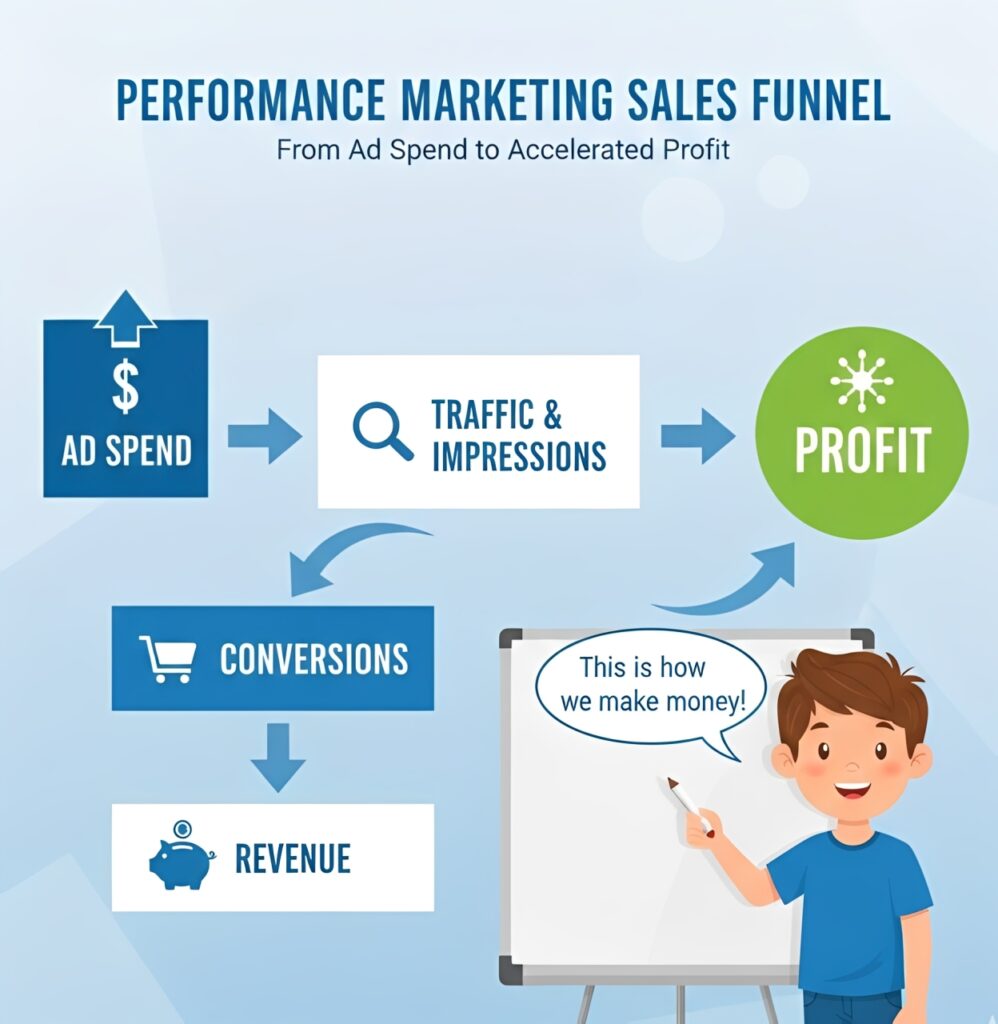
Performance Marketing Strategy Look, we’ve all been there. You’re sitting in a meeting, staring at a slide deck full of “reach” and “impressions.” The numbers look huge. Everyone is nodding like something great is happening. But then you check the bank account, and… nothing. It’s like throwing a massive party where a thousand people showed up, drank all your expensive champagne, and left without saying thank you or buying a single thing.
The digital marketing world is absolutely drowning in expensive-sounding jargon. It’s designed to make you feel like you’re doing something important while your budget quietly disappears into a black hole of “brand awareness.”
If you’re sick of hoping for a “viral moment” that never comes, let’s get real about a Performance Marketing Strategy. This isn’t about being famous; it’s about being profitable. It’s the difference between shouting into a megaphone at a busy intersection and actually shaking someone’s hand to close a deal.
Performance Marketing Strategy : What Are We Actually Talking About?
Let’s strip away the fluff. To get your business moving, you need to adopt a pay-for-performance advertising mindset.
Think about traditional advertising like a billboard. You pay a flat fee to put your face on the side of a highway. Maybe people look at it, maybe they’re too busy staring at their phones or screaming at their kids in the backseat. Either way, the billboard company gets paid, and you’re left guessing if it actually did anything for your bottom line.
In a Performance Marketing Strategy, the power flips back to you. You don’t pay for the “chance” to be seen. You pay when someone actually does something.
That action could be:
- Clicking on your link.
- Handing over their email in a lead generation form.
- Actually buying the product in your cart.
- Downloading your app.
This is the ultimate accountability tool. If the campaign flops, you aren’t left holding the bag for a massive, wasted budget. You’re buying outcomes, not just empty space on a screen.
The 4 Pillars of a Strategy That Actually Works
You can’t just throw money at a “boost post” button and call it a day. That’s a great way to go broke fast. To make this work, you need a foundation built on logic, not just luck. Here are the four horsemen of an ROI-driven digital marketing plan with Best Performance Marketing Strategy:
1. Native Advertising (The Stealth Approach)
Nobody likes being interrupted by a loud, obnoxious salesperson jumping out from behind a bush. Native ads are the opposite. They’re the “Recommended for You” articles or the sponsored stories in your feed that actually match the environment they’re in. They don’t feel like ads; they feel like helpful suggestions. Because they don’t annoy the hell out of the user, they actually get clicked.
2. Social Media & The “Creepy” Good Data
We’ve all had that moment where we talk about wanting a new pair of running shoes, and suddenly, our Instagram feed is full of sneakers. That’s data-driven social media targeting at work. Platforms like Meta or TikTok allow you to find your “tribe” with surgical precision. You aren’t just shouting at “men” or “women.” You’re talking to people who love sustainable fashion, live in a specific zip code, and haven’t bought anything from a competitor in three months. It’s efficient, it’s targeted, and it works.
3. Search Engine Marketing (SEM)
When someone goes to Google and types “emergency plumber near me” or “best organic dog food for seniors,” they aren’t just browsing. They have search intent. They are literally telling the internet they have a problem they want to pay to solve right now. Intent-based marketing captures that person at the exact millisecond they are ready to pull out their credit card.
4. Affiliate Marketing (Your Digital Sales Force)
This is probably the most underutilized tool for growing brands. You partner with people who already have an audience—influencers, bloggers, or review sites. They talk about your product, and you only pay them a commission if they actually land you a sale. It’s a win-win that lets you scale at a speed that would be impossible if you were trying to do it all yourself.
The “Secret Sauce”: Improving Your Marketing ROI
The reason some people are scared of performance marketing is the same reason others love it: The data is brutally honest. You can’t hide a bad campaign behind pretty pictures and “vibes” anymore.
To master CPA optimization (Cost Per Acquisition), you have to stop looking at “likes” and start looking at these three reality-check metrics:
- CPA (Cost Per Acquisition): This is the cold, hard truth. How much did it actually cost you to get one person to buy? If you’re spending $50 to sell a $40 gadget, you don’t have a marketing problem; you have a math problem.
- ROAS (Return on Ad Spend): This is your multiplier. If you put $1 into the machine and $5 comes out, you keep feeding that machine until it stops working.
- LTV (Lifetime Value): Don’t be short-sighted. A customer might cost you $30 to acquire today, but if they stay with your brand for three years, that initial $30 was the best investment you ever made.
The Simple Shift
The “Simple Shift” I mentioned isn’t some secret software or a magic button. It’s a shift in your mindset. It’s about moving away from the ego-stroke of “brand awareness” and moving toward the discipline of marketing budget accountability. It’s about being okay with the fact that not everyone will see your ad, as long as the right people see it and take action.
When you stop paying for “maybe” and start paying for “results,” the whole game changes. You stop being a gambler and start being a strategist. You aren’t just spending money; you’re fueling an engine.
Conclusion: Scaling a Business with Performance Marketing
Stop shouting into the void and hoping someone hears you. Pick one of these pillars—maybe it’s a highly targeted SEM campaign or a small affiliate pilot—set a clear goal, and let the data tell you the truth.
Scaling a business with Performance Marketing Strategy isn’t about having the biggest budget in the room; it’s about having the smartest one. It’s time to stop guessing and start growing.